Vertex-Swarm: fraud detection engine
A real-time, agentic graph-intelligence engine designed to unmask organized dealer collusion and synthetic-identity fraud rings in two-wheeler financing.
The Challenge
Why I built Vertex-Swarm
This project was built as my proposed solution for the TVS Raider challenge. The goal was to solve a real-world case study by providing a framework and proof of concept to address complex synthetic-identity fraud rings in two-wheeler financing.
Traditional fraud detection checks individuals in isolation, completely missing rings of seemingly "clean" applicants who share underlying attributes (like a device, a guarantor, or a dealer). I built Vertex-Swarm to reframe fraud detection as a graph topology problem, analyzing relationships in under 20 milliseconds.
Core Mechanism
- Temporal Graph: Every incoming application is tokenized and added to a continuously updating graph.
- Swarm Agents: A layer of lightweight autonomous agents crawl the graph to identify shapes characteristic of fraud rings.
- Sub-20ms Latency: Designed for live Point-of-Sale (POS) transaction speeds.
Agentic Intelligence
The Swarm Agents
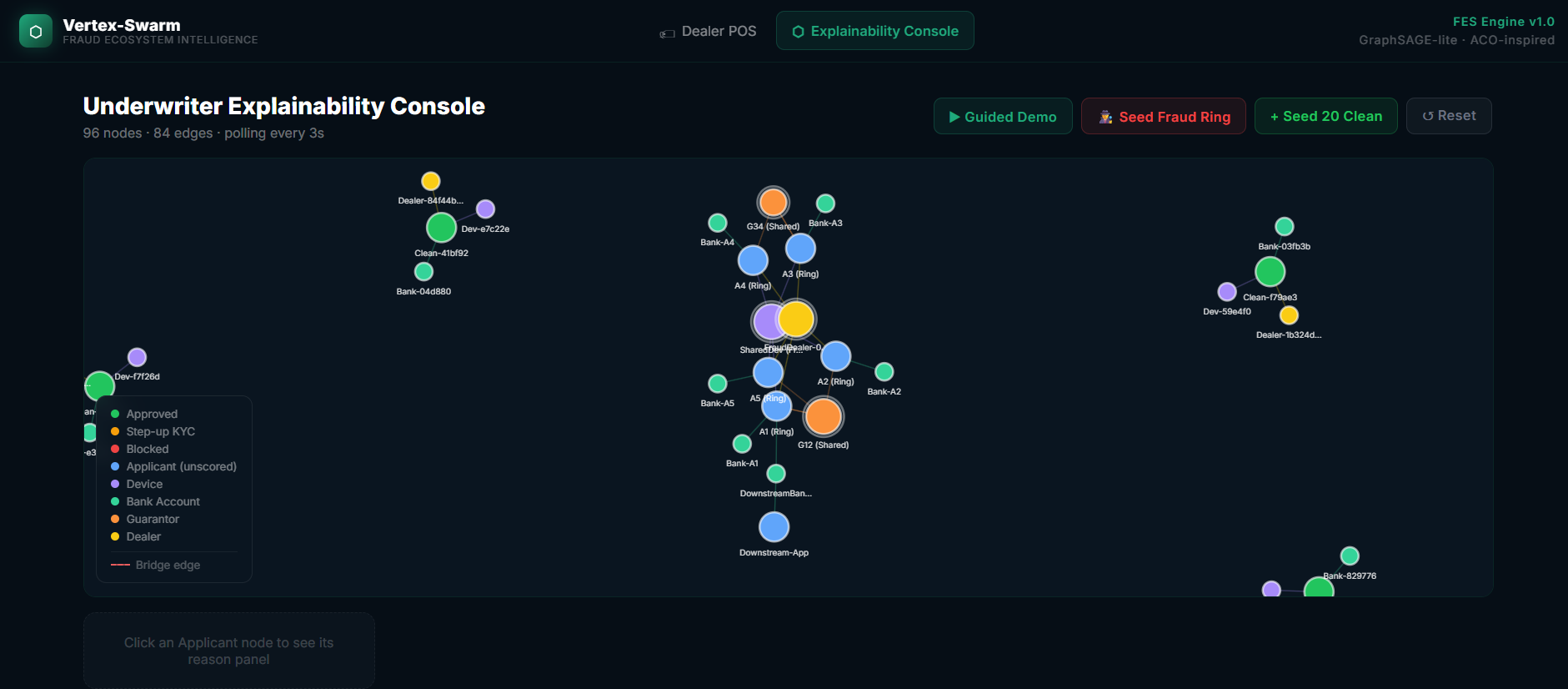
Rather than relying on static rules, Vertex-Swarm deploys specific agents to hunt for distinct fraud topologies:
- Bridge-Finder Agents: Look for single edges connecting otherwise-separate clusters (e.g., a shared device among disconnected groups).
- Density Agents: Measure local subgraph density. Unusually dense neighborhoods indicate high attribute-sharing.
- Loop Agents: Detect repeating guarantor or co-applicant cycles indicative of ring behavior.
Outcome
- Fraud Ecosystem Score (FES): Dense, cyclical clusters receive a higher FES to instantly block coordinated attacks.
- D3 Physics Engine: The frontend uses
react-force-graph-2dto render complex entity relationships visually in real-time.
Architecture
Tech Stack & DevOps
The backend is built in Python with FastAPI for high-performance API endpoints, utilizing NetworkX for in-memory graph operations and topological analysis. The frontend is a fast, modern UI powered by React, TypeScript, and Vite.
The entire environment is containerized using Docker. Cloud deployment is seamless: the backend is configured for zero-config deployment on Render, while the static React app is deployed on Vercel.
Key Modules
graph_store.py: Manages the temporal graph topology.agents/: Contains the logic for the different swarm agents crawling the network.scoring.py: Calculates the final Fraud Ecosystem Score.
Tech Stack